Can't personalize beyond basic email and SMS
Meta ad ROAS went from 17x to 34x with the same catalog
Maestra Platform turns product data into dynamic visuals for ads and email, an all-in-one retention marketing platform for ecommerce brands backed by a forward-deployed marketer who sets it up.
Brands running on Maestra






The problem
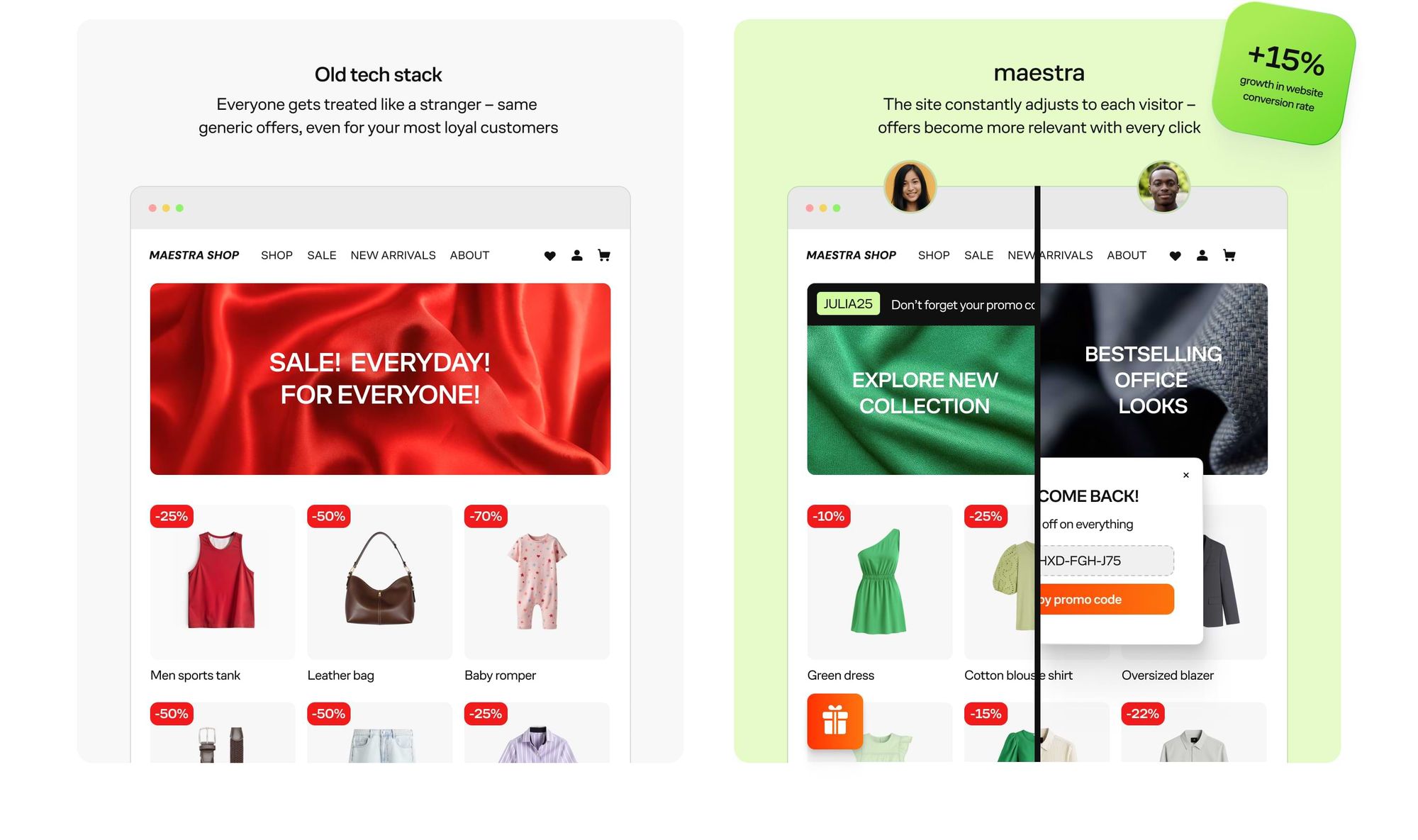
Same homepage, no matter who is looking
Most ecommerce sites still run one static experience for every shopper, regardless of what they have browsed, bought, or asked for. The homepage, the banners, and the product grid look the same whether it is a first-time visitor or someone on their twentieth order. That flattens the exact signals a brand has already collected.
What we hear from brands
the site experience is static and manually merchandised, offering the same journey to all visitors, according to a French skincare brand
the website is bulky and generic, lacking dynamic personalization, according to a premium appliance brand
the website experience is static, with the same banners for all visitors, according to an independent fragrance boutique
The new way
Move fast without a developer queue
Popups and banners can go live from a template gallery in minutes. More advanced setups, like custom recommendation logic or dynamic product visuals, are handled by Maestra's team at no extra cost, so marketing does not wait on engineering to ship a test.
Outcomes brands report
9%
incremental revenue versus the control group from website personalization
From a published case studyCustomer proof
Magnum Bikes unifies a journey that never moved in a straight line

Magnum Bikes customers research online, visit a retail store, and register a product later, but Klaviyo could not support that kind of distinct customer journey: no unified profiles, no product-specific targeting, no real-time on-site personalization. Moving to Maestra unified profiles across online and offline touchpoints and added product-specific flows, geo-targeted campaigns, and on-site personalization including lead forms and PDP blocks.
+56.6%
in online revenue, 2025 on Maestra vs. 2024 on Klaviyo
+111.7%
in online order volume
 Read the full case study
“Our customers don't buy in a straight line. They research online, visit a retail store, register a product later. Maestra unifies that entire journey into one profile.”
How it works
The migration plan, in three plain steps
Grant access
Your forward-deployed marketer needs visibility into your current setup to plan the move. That access is the starting point.
Review the plan, then step back
Once you approve the roadmap, your dedicated forward-deployed marketer handles data migration, integrations, and flow rebuilding, covering the vast majority of the work.
Launch with deliverability already warmed
Domain warm-up happens before go-live, so your first sends on Maestra do not start from a deliverability deficit.
The platform
What makes Maestra different starts with the data model
Most platforms bolt commerce features onto a generic data model. Maestra built its data model around products, orders, and customer status from day one, which is why ten modules can share it cleanly. That foundation runs at 2M RPM with under 300ms processing.
Including
Your forward-deployed marketer
Direct access, not a support ticket
Every Maestra account gets a shared Slack channel with its forward-deployed marketer, so questions get answered in minutes, not after a ticket sits unassigned for days.
Shared Slack channel with your marketer
5-minute response time versus 72 hours
Included with every subscription
Replace your stack
The overlap audit that leads to Maestra
Auditing every tool that touches customer data usually turns up several doing the same job. Once that overlap is mapped, one platform can absorb most of it. That is the case Maestra makes against a stack built from separate email, SMS, recommendation, and loyalty tools.
Not ready to switch? Start by looking around
See the modules, the data model, and the support model before you talk to anyone.